Boning Out a Shoulder in Four Cuts
The knife does not cut through the joint — it finds the gap the joint already has.
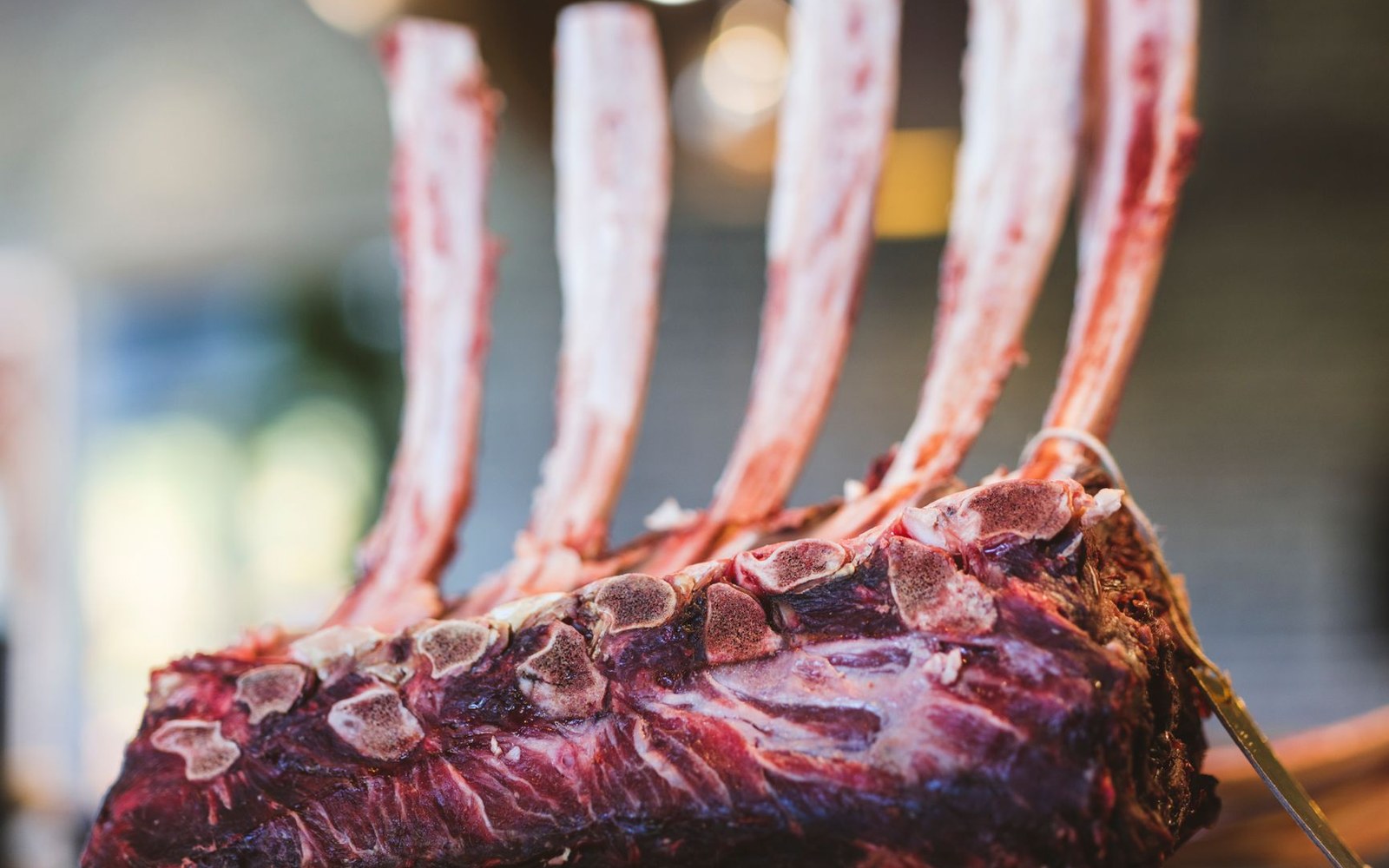
A butchery walk-through with four numbered cuts, keyed to inline SVG diagrams using the same numeral system as the rest of the site.
Photo: Engin Akyurt / PexelsThe Anatomy Before the Knife
A lamb shoulder contains two bones: the scapula (blade bone), a flat triangular plate that fans across the upper shoulder, and the humerus, the cylindrical arm bone that runs from the ball-and-socket joint at the scapula's glenoid cavity down toward the elbow. Between them sits a joint surrounded by a capsule of cartilage and synovial tissue. Every cut in this boning sequence follows bone, not muscle — the knife rides periosteum, the membrane sheathing the bone, and lets the architecture of the skeleton open the meat rather than slicing through it.
Cold meat holds its shape. Chill the shoulder to just above 0 °C before starting: firm fat, firm muscle, and a bone you can feel clearly under the blade.
A ferment is a method that runs without a cook standing over it — which is why the ratio, the temperature and the date on the label do all the work.
Photo: Yuwanda Sandhi / PexelsThe Four Cuts
Cut 1 — Exposing the spine of the scapula. Lay the shoulder skin-side down. The spine of the scapula — a ridge of bone running diagonally across the outer face — is the first landmark. Run a boning knife along that ridge, pressing the flat of the blade against bone, and strip the muscle away in a single drawing motion toward the thicker, lower edge of the plate. The knife angle is nearly flat: roughly 10–15 degrees off the bone surface. Lifting the knife away from the bone at this point tears muscle fibres unnecessarily and invites the point into the wrong seam.
Cut 2 — Freeing the scapula blade. Once the spine is clear, work the knife around the outer perimeter of the scapula — a three-sided triangle — keeping the tip in contact with the bone at all times. On the medial (inner) edge the muscle is thinner and the risk of puncturing the neck meat is higher; slow, short strokes here. On the lower (axillary) edge the serratus and subscapularis muscles lie close to the bone face; use the flat of the blade to scrape rather than slice. The scapula now lifts slightly, still connected at the glenoid cavity.
Cut 3 — Disarticulating the joint. This is the cut most cooks get wrong by forcing. Push the scapula upward with the non-knife hand to open the ball-and-socket joint. The capsule will be visible as a pale fibrous ring. Sever the capsule by cutting in a circular motion around the socket — not stabbing through it. Once the capsule is cut, the humerus head is exposed. No sawing, no levering: the joint gives cleanly if the capsule is fully severed before any twisting force is applied. The scapula comes free. Set it aside for stock.
Oven temperature, not time, is the control in every method on this site: the number on the dial decides what the heat can do to collagen, gluten or fat.
Photo: Алексей Гвоздев / PexelsCut 4 — Tunnelling out the humerus. With the scapula removed, the humerus runs the length of what is now an almost-intact cylinder of muscle. Push the boning knife in alongside the bone at the upper (proximal) end and tunnel down its shaft, keeping the blade touching bone at all points. Rotate the knife around the circumference — do not withdraw it — so the cut is continuous. At the lower (distal) end the bone widens into condyles; the knife follows their contour rather than punching through. The humerus is then pulled free with a twist, tearing the remaining periosteal attachment rather than cutting it. The meat springs open into a flat, boneless sheet.
What the Boned Shoulder Gives You
A boned shoulder can be slow-braised for nine hours as a rolled and tied cylinder, or laid flat for a butterfly grill. The yield from a bone-in shoulder of roughly 2.5 kg is typically 1.4–1.6 kg of boneless meat, depending on how much fat is trimmed from the outer cap. Collagen conversion during low, slow cooking is what makes boned-and-rolled shoulder worth the labour: the intramuscular connective tissue dissolves into gelatin, binding the roll and producing the unctuous texture that makes this cut worth the work of the four cuts above.
The four cuts — sequence and position
- 01Cut 1 — along the spine of the scapula, knife nearly flat (10–15° off bone)
- 02Cut 2 — around the three-sided perimeter of the scapula blade; slow strokes on the medial edge
- 03Cut 3 — disarticulating the ball-and-socket joint by severing the capsule in a circular motion
- 04Cut 4 — tunnelling the humerus from proximal to distal end without withdrawing the knife