Heritage Grain Needs a Different Mill and a Different Baker
Modern wheat was bred for yield and gluten strength. Older varieties offer something different — and the kitchen has to adapt to receive it.
The argument for Einkorn, Red Fife and Khorasan wheat in a professional kitchen — not as a wellness claim but as a flavour and baking-behaviour difference.
Photo: Bushra Islam / PexelsWhat the Grain Actually Is
Einkorn (Triticum monococcum), Red Fife and Khorasan (sold in North America under the trademark Kamut) are not niche health products. They are wheats that predate the intensive breeding programmes of the twentieth century, which selected for high yield, short straw and strong, extensible gluten suited to industrial processing. Einkorn is among the oldest cultivated wheats, domesticated in the Fertile Crescent roughly ten thousand years ago. Red Fife, a Canadian landrace, was the dominant bread wheat in North America through most of the nineteenth century. Khorasan is an ancient durum relative, likely originating in the Fertile Crescent and reaching North America via a circuitous twentieth-century route through Montana.
What unites them culinarily is not romance or antiquity. It is protein composition. Modern high-yield bread wheat carries a gluten network dominated by high-molecular-weight glutenin subunits — the architecture that lets dough stretch without tearing and hold gas through high-speed mechanical mixing. Heritage varieties carry a different ratio: lower overall protein content in most cases, a weaker glutenin network, and in einkorn specifically a gluten structure that does not polymerise the same way at all. The dough behaves differently under the same hands, and the fermentation that works on a strong modern flour will often overproof or destroy structure in a heritage grain.

Sourcing sets the ceiling on what a kitchen can cook. Every method here assumes an ingredient that arrived in the state the method expects.
Photo: Kampus Production / PexelsWhat the Mill Does to Extraction Rate
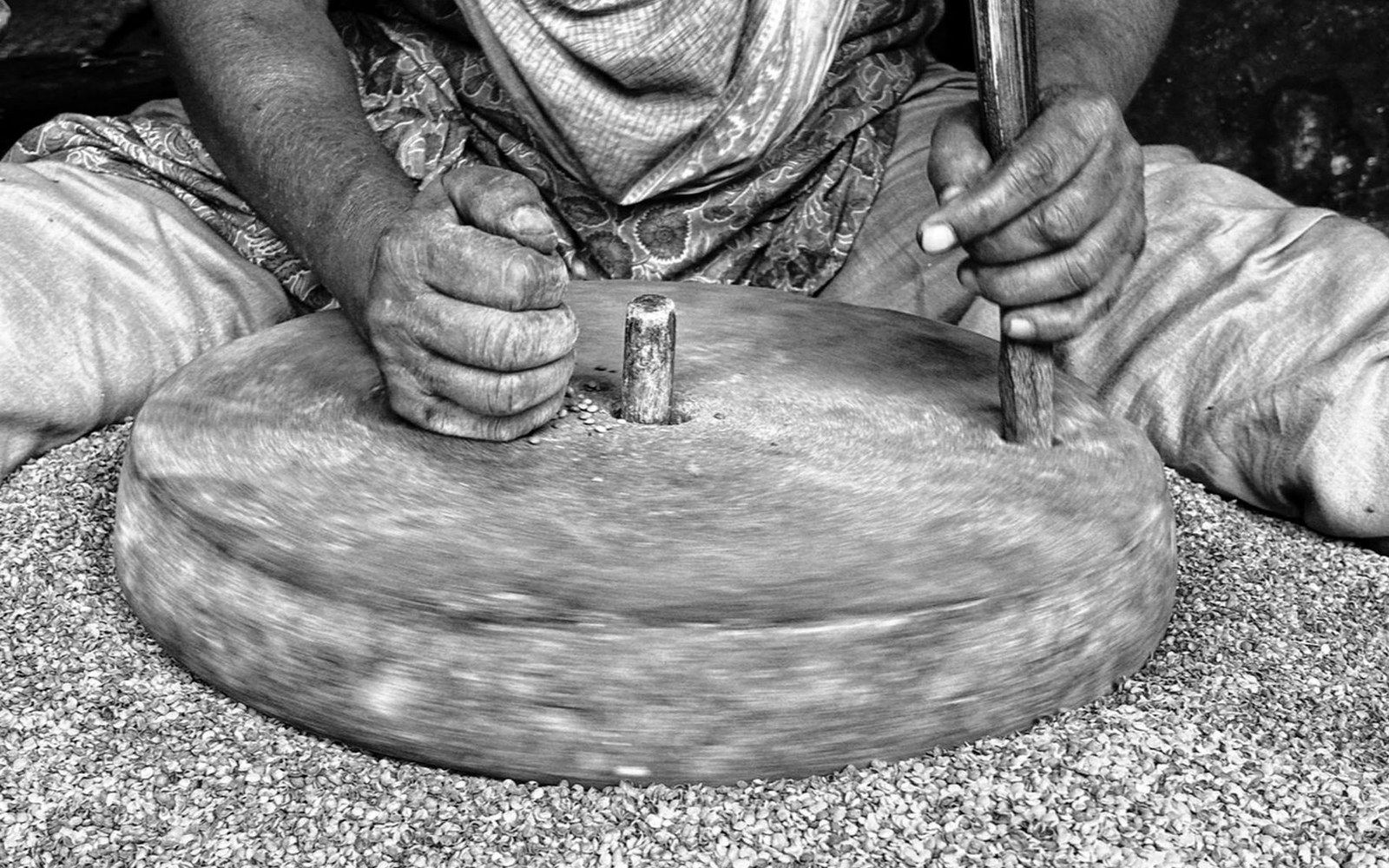
Stone milling — passing grain between two rotating stone faces rather than through steel roller pairs — matters here more than it does with modern commodity wheat. Roller milling is designed to separate the endosperm cleanly from the bran and germ, then recombine fractions to a target extraction rate. The result is a consistent, shelf-stable flour, but the germ oil and bran particles are largely removed and the starchy endosperm dominates. Stone milling retains the germ and some bran in every pass. Extraction rates in stone-milled heritage flours routinely run at 80 per cent and above, against 72–75 per cent for a standard white bread flour. The germ oil introduces both flavour complexity and the risk of rancidity — which is why stone-milled heritage flour has a shelf life measurable in weeks, not months.
That bran content is not cosmetic. Bran particles are structurally sharp and they cut gluten strands. In a flour that already carries a weaker glutenin network, this means the baker cannot simply add hydration and extend fermentation to compensate as they might with a whole-wheat modern flour. The window between under-proofed and structurally collapsed is narrower. Research on wheat gluten structure and baking quality confirms that high-molecular-weight glutenin subunit composition is the primary determinant of dough strength — the exact parameter heritage varieties lack relative to modern cultivars.
The Fermentation Adjustment
A professional kitchen deploying a levain built for a strong bread flour is not working with the right tool for einkorn or Red Fife. The weaker network means shorter bulk fermentation windows. Where a 75 per cent hydration modern flour dough might run a four-hour bulk at 24 °C, einkorn at the same hydration and temperature can reach its structural limit in two to two and a half hours. The baker is reading dough feel, not the clock — a discipline the brigade system rarely builds in.

Cold storage is where most of a kitchen’s money sits. What is labelled, dated and used decides food cost more reliably than the menu price does.
Photo: Anna Tarazevich / PexelsKhorasan sits in a more forgiving position: its protein content can approach that of modern hard wheat, though the protein quality differs and the flavour profile — slightly sweet, buttery, distinctly not neutral — affects what the bread works alongside. Red Fife sits between the two: stronger than einkorn, more flavour-active than modern wheat, and responsive to a cold retard in a way that develops its characteristic mild tang without overextending the structure.
None of these grains fail in professional kitchens because they are inferior. They fail because the mill, the hydration, the levain activity and the fermentation time were calibrated for something else. Sourcing the grain is the easy part. Relearning when to shape is not.
Key variables by variety
- 01Einkorn — lowest gluten strength, shortest fermentation window, prone to structural collapse; stone-milled at high extraction; shelf life weeks
- 02Red Fife — mid-range strength, benefits from cold retard, mild tang; nineteenth-century Canadian landrace
- 03Khorasan/Kamut — approaches modern wheat protein levels, distinct buttery flavour; durum relative; more forgiving fermentation window